Glutamine: what it is, when to take it and what EFSA says
What glutamine is, where it is found in food and why it has no authorised health claims in the EU. Then when and how much to take according to labels, powder or capsules, BCAA blends and who should see a doctor first.
Glutamine is the most abundant amino acid in the human body, and the body makes it on its own, mostly in the muscles. In supplements you find it on its own, as a powder, capsules or tablets, or inside blends with other amino acids. This guide explains what it is, where it is found in food, what EFSA assessed, what labels say about timing and dose, and how to read them.
The key point first: in the European Union there is no authorised health claim for glutamine. Not on muscles, not on recovery after training, not on the immune system. You will see why further down.
What is glutamine?
Glutamine is one of the twenty amino acids that make up proteins. The form found in food and supplements is L-glutamine: when a label says “glutamine” or “L-glutamine”, it is the same substance.
Nutritionally it is a non-essential amino acid: the body makes it from another amino acid, glutamate. According to a review published in 2018 in the journal Nutrients, a healthy person of about 70 kg has 70 to 80 g of glutamine in the whole body, and the body's own production is estimated at 40 to 80 g a day. Skeletal muscle is the main site where glutamine is stored, made and released.
Some tubs say “conditionally essential amino acid”. The term comes from medicine: in strongly catabolic conditions, such as serious illness, surgery, trauma or major infections, the body may use more than it makes. These are clinical situations, managed by a doctor.
Where is glutamine found in food?
Glutamine is present in relatively high amounts in protein foods, of both animal and plant origin. The 2018 review reports, for example, about 1.2 g of glutamine per 100 g of beef and about 0.6 g per 100 g of egg or tofu. The same review cites a study of more than 70,000 people, in which average dietary glutamine intake was about 6.9 g a day. A balanced diet, the authors conclude, provides glutamine along with the other amino acids.
Protein powders also contain glutamine, as part of their amino acids.
Glutamine, muscles and recovery: what does EFSA say?
Between 2009 and 2011 EFSA, the European Food Safety Authority, assessed several claims on glutamine; the main opinion is the one published in the EFSA Journal 2011;9(6):2225. The table sums up the glutamine entries in the EU register of health claims, grouped by effect.
| Proposed effect | Reason for rejection | Status in the EU |
|---|---|---|
| Growth or maintenance of muscle mass | Effect not substantiated by the evidence assessed | Not authorised |
| Repair of muscle tissue | Effect not substantiated by the evidence assessed | Not authorised |
| Faster restoration of muscle glycogen after strenuous exercise | Effect not substantiated by the evidence assessed | Not authorised |
| Attention, working memory, neurological function | Effect not substantiated by the evidence assessed | Not authorised |
| Immune system | Effect not substantiated, not defined well enough to be assessed, or not beneficial under the Regulation, depending on the entry | Not authorised |
| Gut: lining, permeability, defence against microorganisms | Effect not substantiated, or not beneficial under the Regulation, depending on the entry | Not authorised |
“Not beneficial under the Regulation” does not mean glutamine is harmful: it means that the effect described in the application is not, under EU law, a beneficial physiological effect that a label may promise. “Not defined well enough” means the wording was too vague to be checked.
In practice: in the EU register every glutamine entry is listed as not authorised. A label or product description that, in Europe, promises muscle, recovery, less catabolism or immune support from glutamine is using a claim the law does not allow.
When to take glutamine: after training or before bed?
No time of day is linked to an authorised effect. Before or after training, or in the evening: product pages give different directions, and none of them rests on an authorised health claim. Some examples:
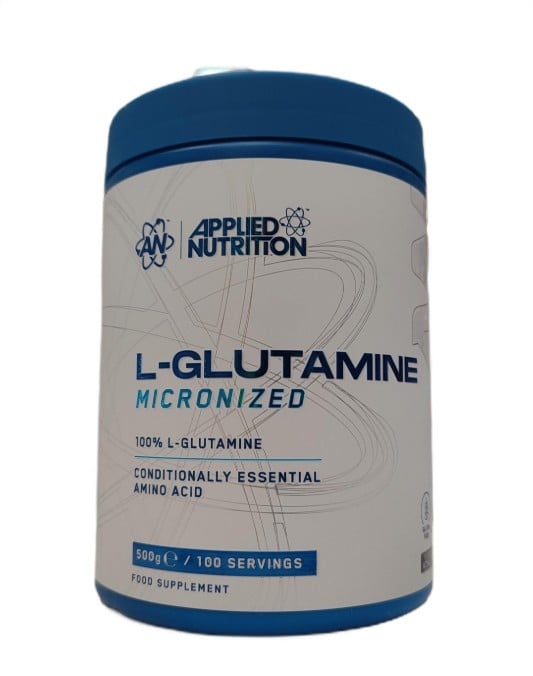
- Applied Nutrition L-Glutamine 500 g gives a 5 g serving, one to three times a day with meals, with one serving straight after training;
- Jarrow Formulas L-Glutamine 750 mg gives one capsule once or twice a day, on an empty stomach or after training;
- Nutrend Glutamine gives one serving after training and, if needed, a second one in the evening before bed.
Follow the directions on your pack: they are the ones the manufacturer printed for that product and that dose.
How much glutamine to take, and for how long?
Label doses vary a lot with the form. Pure powders usually measure 5 g per serving, that is 5,000 mg: with three servings a day, as Applied Nutrition directs, that comes to 15 g. A Jarrow capsule holds 750 mg instead, so two capsules make 1.5 g a day. When you compare two products, look at the grams per serving and the servings per day, not at the number of scoops or capsules. The guide to label units explains how to read grams and milligrams.
In the Italian Ministry of Health guidelines on “other nutrients” (October 2022 revision) glutamine has no entry of its own with an intake limit: what applies is the daily dose and the warnings the manufacturer prints on the pack, which should not be exceeded. The product pages we read give a daily dose, not a duration: for long-term use, or if you have a medical condition, ask your doctor.
The glutamine supplements available are in the glutamine category.
Glutamine powder, capsules or tablets: what is the difference?
The substance is the same; the format and the doses change.
- Powder: doses in grams, mixed into water or juice. “Micronised” means finer particles that disperse better in liquid;
- capsules and tablets: fixed doses, for example 750 mg in the Jarrow capsule and 1,000 mg in the Jarrow tablet, with no scoop and no taste. Reaching the grams of a powder serving takes several units;
- origin: the product pages of some products, such as Jarrow and Nutrend, state L-glutamine made by fermentation. AjiPure, named on the Swanson powder page, is the amino acid brand of the Japanese company Ajinomoto.
If you compete in a drug-tested sport, some manufacturers have their batches tested: the Applied Nutrition product page mentions Informed Sport testing and advises checking the batch number on your pack in the programme's database.
BCAA with glutamine: how do you read a blend?
Many products combine glutamine with the branched-chain amino acids (leucine, isoleucine and valine). In a blend, read the nutrition table: check that for each serving it shows the amount of every amino acid, not just the total.
For the branched-chain part, the Italian Ministry of Health rules apply: at most 5 g a day as the sum of leucine, isoleucine and valine, and the warning not to use them in pregnancy, in children or for long periods without asking a doctor. Blends are in the BCAA category; leucine is covered in the leucine guide.
Glutamine, glutamate, pyroglutamate: are they the same?
No. Labels use names that look alike but refer to different substances:
- glutamate or glutamic acid: the amino acid from which the body makes glutamine. It is not glutamine;
- arginine pyroglutamate: an arginine supplement, a different amino acid, not a glutamine one;
- arginine alpha-ketoglutarate (AAKG) and ornithine alpha-ketoglutarate (OKG): substances with their own entries in the Ministry guidelines;
- glutathione: yet another substance, with its own entry and a limit of 250 mg a day in the same guidelines.
Who should ask a doctor before taking glutamine?
The product page for Jarrow L-Glutamine 750 mg asks you to consult a doctor before use in these cases:
- pregnancy and breastfeeding, and age under 18;
- taking medication or having a medical condition, in particular epilepsy or seizures, mania and severe liver disorders.
The same page says to stop use if any adverse reaction occurs. Anyone looking for information on glutamine and the prostate, or on any other condition, should know that there is no authorised claim on these topics: for a condition or an ongoing treatment, the doctor decides. If your label shows different warnings, follow the ones on your pack.
Glutamine in brief
- What it is: the most abundant amino acid in the body, which the body makes itself, mostly in the muscles.
- Where it is found: in protein foods, animal and plant; a balanced diet provides several grams a day.
- EFSA and EU: no authorised health claim, neither on muscles and recovery nor on the immune system and the gut.
- When: no time of day is linked to an authorised effect; follow the label.
- Dose: 5 g per serving in powders, 750 mg in the capsule and 1,000 mg in the tablet of the examples; do not exceed the daily dose.
- Blends with BCAA: the limit for the branched-chain amino acids is 5 g a day.
- Warnings: pregnancy, under 18, medication, epilepsy, liver disorders: see a doctor first.
This guide is for information only and does not replace medical advice. Product information comes from the labels and descriptions published on the product pages as of 26/11/2026: the label on the pack you receive is what counts.
Products in this guide
- -10%
