Bolero Drink: what it is, ingredients, calories and safety
9 g sachets, Ice Tea and Sticks: ingredients, calories and dilution read from the labels. What acesulfame K, sucralose and stevia are, what EFSA says and why Bolero does not make you lose weight.
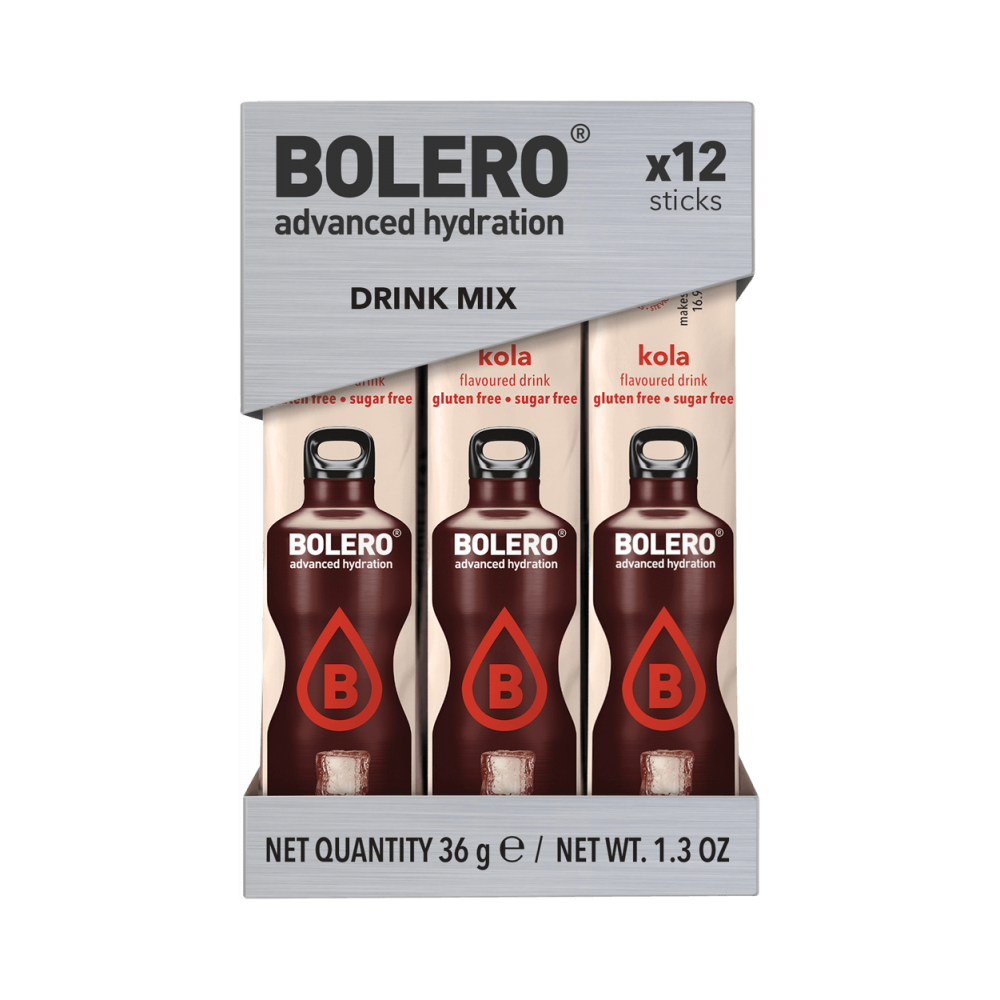
Bolero is a powder you dissolve in water to make a flavoured drink with no added sugar. A classic 9 g sachet makes 1.5 litres; a 3 g stick makes half a litre. According to the labels read, the prepared drink provides between 1.2 and 1.9 kcal per 100 ml. This guide reads the distributor's labels and answers the most searched questions: whether it is bad for you, whether it helps you lose weight and whether you can drink it every day.
The rule to remember: ingredients change from one flavour to another. Before drinking, read the list printed on the sachet of the flavour you chose. This guide does not replace that label.
What is Bolero: a supplement or a drink?
On the sachet Bolero describes itself as a "fruit flavoured drink with no sugar added". So the label presents it as a flavoured drink, not as a food supplement. You find it among the shop's supplements because people who train use it to flavour the water in their bottle.
According to the Italian labels published on the product pages, it is made in Bulgaria and distributed by Naskorsports, based in the Netherlands. The front of the sachet also carries the badge "with steviol glycosides / stevia extracts". Stevia is not the only sweetener, though, as the ingredient list shows.
Bolero 9 g, Ice Tea and Sticks: how much water?
The format changes the amount of powder and therefore the water to dissolve it in. Dilutions are the ones printed on the packs.
| Format | Powder per sachet | Water |
|---|---|---|
| Bolero Drink | 9 g | 1.5 litres |
| Bolero Ice Tea | 8 g | 1.5 litres |
| Bolero Sticks | 3 g | 0.5 litres |
Mixed Packs are assortments of classic 9 g sachets in different flavours. Sticks are the gym-bag format: one stick is enough for a half-litre bottle. The available flavours are listed in the selector on each product page and on the Bolero brand page.
Bolero ingredients: what is inside?
These are the ingredients from the labels read in full, in the order they are printed.
- Classic 9 g sachets (Mixed Packs label): acids (citric acid, malic acid), ginger extract (in the ginger flavour), maltodextrin, flavourings, sweeteners (acesulfame K, sucralose, steviol glycosides), acidity regulator (sodium citrate), anti-caking agent (calcium phosphate), thickeners (guar gum, gum arabic), L-ascorbic acid (vitamin C). The multivitamin flavour adds vitamin E and vitamin A. Colours change from flavour to flavour and the label lists them next to each flavouring: for example carrot concentrate, curcumin, beta-carotene, copper complexes of chlorophylls, and sulphite ammonia caramel in the cherry-cola and cola flavours.
- Sticks, Cola flavour: acids (citric acid, malic acid), maltodextrin, flavourings, sweeteners (acesulfame K, sucralose, steviol glycosides), acidity regulator (sodium citrate), anti-caking agent (calcium phosphate), thickeners (guar gum, gum arabic), colour (sulphite ammonia caramel).
- Ice Tea, Peach and Lemon flavours: acid (citric acid), black tea extract (22.5%), maltodextrin, flavourings, sweeteners (acesulfame K, sucralose, steviol glycosides), acidity regulator (sodium citrate), anti-caking agent (calcium phosphate), thickeners (guar gum, gum arabic), L-ascorbic acid (vitamin C).
Caramel appears in the cola flavours. Do not assume it is present, or absent, in other flavours: check the sachet. If an online description says something different from the label, the label wins.
How many calories does Bolero have, and why "no added sugar"?
The labels state values for the powder and for one sachet. Dividing by the litres stated gives the calories of the prepared drink.
| Format | Per sachet | Carbohydrate per sachet | Prepared drink |
|---|---|---|---|
| Classic 9 g sachet | 29 kcal | 4 g | 29 kcal in 1.5 litres: about 1.9 kcal per 100 ml |
| Sticks 3 g (Cola) | 6 kcal | 0.8 g | 6 kcal in 500 ml: 1.2 kcal per 100 ml |
| Ice Tea 8 g (Peach, Lemon) | 18 kcal | 2.8 g | 18 kcal in 1.5 litres: 1.2 kcal per 100 ml |
Sugars, fat, protein and salt are declared at 0 g on all three labels. The carbohydrate comes from maltodextrin, a carbohydrate made from starch. In law it is not a "sugar": that term means mono- and disaccharides. Regulation (EC) 1924/2006, in its annex on nutrition claims, allows "no added sugars" only if the product contains no added mono- or disaccharides and no other food used for its sweetening properties.
Does Bolero help you lose weight?
No. The label lists no ingredient with a stated effect on weight, and the pack makes no such promise. Bolero is a very low-calorie drink: it does not remove calories, it adds very few.
The difference only shows when you compare it with what you would drink instead. A litre and a half of prepared classic Bolero provides 29 kcal, of Ice Tea 18 kcal. To see how much changes against a sugary soft drink, multiply the kcal per 100 ml on its label by the millilitres you drink, and do the same for Bolero. It is a calculation about the drink, not a forecast about your weight, which depends on your diet as a whole.
Is Bolero bad for you? Sweeteners, caramel and kidneys
Bolero's additives are authorised in the European Union and EFSA, the European Food Safety Authority, has assessed their safety. For each one it has set an acceptable daily intake (ADI): the amount that can be consumed every day over a lifetime without appreciable risk, expressed per kilogram of body weight.
| Additive | ADI | Assessment |
|---|---|---|
| Acesulfame K (E 950) | 15 mg per kg per day | EFSA re-evaluation 2025, which raised the previous value of 9 mg |
| Sucralose (E 955) | 15 mg per kg per day | EFSA re-evaluation published in 2026, which confirmed the value |
| Steviol glycosides (E 960) | 4 mg per kg per day, expressed as steviol | EFSA opinion 2010, value kept in later opinions |
| Caramels (E 150a-d), including sulphite ammonia caramel (E 150d) | 300 mg per kg per day, as a group | EFSA opinion 2011 |
For acesulfame K EFSA concluded that the highest exposure estimate is generally below the ADI in all population groups; for sucralose, that it stays below the ADI at authorised uses. Bolero's labels, however, do not state how many milligrams of each sweetener a sachet contains: so you cannot work out how many litres a day would reach the ADI, and you should distrust anyone who does.
What about the kidneys? The EFSA assessments cited concern the general population and are not an opinion on your health. If you have kidney disease or follow a prescribed diet, take the full ingredient list to your doctor and ask whether the drink suits you.
Can you drink Bolero every day?
The Sticks label read for this guide states no daily limit: it only asks you to dissolve the sachet in the amount of water given. Keeping to the dilution matters, because a more concentrated drink provides more additives per glass.
Bolero Ice Tea is different: its label carries its own warnings, to be read before buying. The printed text asks you not to consume 800 mg or more of (-)-epigallocatechin-3-gallate a day, not to give it during pregnancy or breastfeeding, to under-18s or over-70s, and to see a doctor if health problems appear. It also carries statements about cholesterol-lowering medicines and red yeast rice products. Follow them as written on your pack.
The classic sachets' label has a note too: for the multivitamin flavour, which contains vitamin A, it asks you to take vitamin A supplements during pregnancy only after consulting a doctor.
Does Bolero contain minerals and vitamins?
No minerals, according to the labels read: salt is declared at 0 g and no mineral appears in the nutrition declaration. Bolero flavours water, but it is not an electrolyte drink. If that is what you need, look at the nutrition table of electrolyte products and compare sodium and potassium.
Vitamin C appears on the classic sachet and Ice Tea labels: 90 mg per sachet, 113% of the Nutrient Reference Values, spread over 1.5 litres of drink. It is not declared on the Cola Sticks label. How to read the NRV percentage is explained in the guide to label units.
To compare formats on price, use the cost per litre: divide the pack price by the number of sachets, then by the litres each one makes. A 0.5-litre stick and a 1.5-litre sachet cannot be compared sachet for sachet.
Bolero in short
- What it is: a powdered drink mix with no added sugar, presented on the label as a drink, not as a supplement.
- Dilution: 9 g and 8 g in 1.5 litres, the 3 g stick in half a litre.
- Calories: from 1.2 to about 1.9 kcal per 100 ml of prepared drink, on the labels read.
- Sweeteners: acesulfame K, sucralose and steviol glycosides, all assessed by EFSA with an acceptable daily intake.
- It does not make you lose weight and does not replace electrolytes: it flavours water.
- Ice Tea: read the label warnings before buying.
This guide is for information only and does not replace medical advice. Ingredient and nutrition information comes from the labels published on the product pages on 23/11/2026: the label on the pack you receive is what counts.
Products in this guide
- -60%


- -60%


- -60%


- -60%

