
Creatine and taurine together, and other practical questions
Can you take creatine and taurine together? What the EU register and the Italian Ministry of Health guidelines say, how much creatine to take even if you weigh 85 kg, how to measure 3 g, how much water it needs and what creatine chewables are.
The most common creatine questions are not about which one to buy but how to use it: can you take it with taurine? How much do you need if you weigh 85 kg? How much water does it take to dissolve? And are chewable tablets the same thing? This guide answers with what the EU register, the Italian Ministry of Health guidelines and published measurements say. To choose between monohydrate, micronised and the other forms, see our guide to choosing creatine.
Can you take creatine and taurine together?
Yes: no rule forbids it, and some products already contain both. The Italian Ministry of Health guidelines on food supplements (October 2022 revision) treat them as two separate substances, each with its own daily limit:
| Creatine | Taurine | |
|---|---|---|
| Daily limit in supplements (Italy) | 3 g; up to 6 g in products for athletes, for no more than one month | 1000 mg |
| Label warnings (Italy) | adults only; do not use during pregnancy | none specific |
| Health claims authorised in the EU | two, both with the 3 g a day condition | none |
The key point is that taurine, unlike creatine, has no authorised health claim: in the EU register all 14 entries that concern it, from energy metabolism to the immune system, are listed as not authorised. There is no authorised claim for the combination either. People who take the two together do so for convenience, not because the law recognises an effect of the pair.
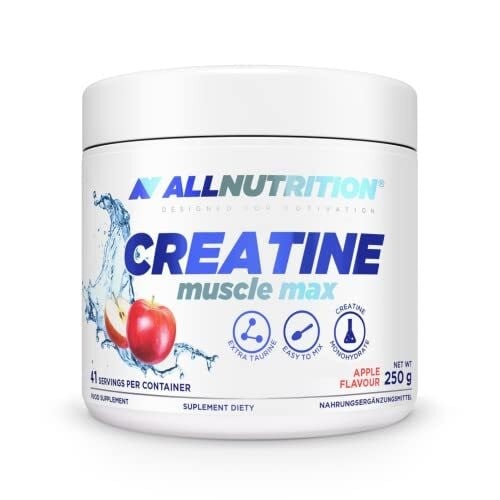
One combined product is ALLNUTRITION Creatine Muscle Max: a 6 g serving declares 4,050 mg of creatine monohydrate and 450 mg of taurine. If you also use a pre-workout or a drink with taurine, add the amounts up before you pass 1000 mg: Applied Nutrition taurine powder, for example, gives 1 g per serving.
What does the law say about creatine?
In the European Union creatine has two authorised claims. The first applies to adults performing high-intensity exercise: "Creatine increases physical performance in successive bursts of short-term, high intensity exercise." The beneficial effect is obtained with a daily intake of 3 g of creatine.
The second, added in 2017, concerns adults over 55: "Daily creatine consumption can enhance the effect of resistance training on muscle strength in adults over the age of 55." It applies with 3 g a day combined with resistance training that increases the workload over time, at least three times a week for several weeks, at an intensity of at least 65-75% of one-repetition maximum.
How much creatine should you take? What if you weigh 85 kg?
The legal reference is 3 g of creatine a day, the same for everyone: neither the EU claim nor the Italian guidelines adjust the amount to body weight. For products aimed at athletes, the Italian Ministry allows up to 6 g a day for no more than one month.
The scientific literature does describe weight-based "loading" protocols: the International Society of Sports Nutrition position stand (2017) describes about 0.3 g per kg a day for 5-7 days, then 3-5 g a day. For an 85 kg person that would be about 25 g a day in the first week, four times the maximum allowed in Italy for a supplement. That is why we do not recommend them: if you want to follow a protocol different from the label, talk to your doctor first. The same applies if you take medication or have a medical condition.
How do you measure 3 g of creatine?
Three things to keep in mind:
- Scoops are not a standard. Every brand has its own, and the label says how many grams it holds. Without a scoop, a kitchen scale accurate to 0.1 g does the job. 3000 mg is 3 g.
- Creatine monohydrate is not pure creatine. Monohydrate is about 88% creatine (87.9% according to the literature): 3 g of creatine monohydrate gives about 2.64 g of creatine, and you need about 3.4 g of monohydrate to reach 3 g of creatine. Creatine Muscle Max states it on the label: 4,050 mg of monohydrate, equal to 3,565 mg of creatine.
- In combined products the serving is not all creatine. A 6 g serving with taurine, flavourings and sweetener contains less than 6 g of creatine: read the creatine line in the table, not the serving weight.
How much water does creatine need to dissolve?
Creatine is not very soluble, and how much dissolves depends on water temperature. According to measurements published in 2011 by Jäger and colleagues, one litre of water dissolves:
| Water temperature | Creatine dissolved in 1 litre | Minimum water for 3 g |
|---|---|---|
| 4 °C (fridge) | 6 g | about 500 ml |
| 20 °C (room) | 14 g | about 215 ml |
| 50 °C | 34 g | about 90 ml |
Acidic drinks dissolve more, because lowering the pH increases solubility: that is why many flavoured creatines contain citric acid. With cold water from the fridge it is normal to see some sediment: shake and drink it all, including what is left in the glass. Micronised creatine disperses better, but it is the same substance.
What are creatine chewables for?
They are creatine in tablets you chew, with no water or shaker: for example Mutant Creatine Bytz and Animal Creatine Chews. The substance is the same as the powder, and the same rule applies: the authorised claim only applies if the product provides 3 g of creatine a day.
Before choosing them check three things on the pack: how much creatine each tablet contains, how many tablets make 3 g and how much sugar or sweetener the dose carries, because chewables are almost always sweetened to taste good. Compared with an unflavoured creatine powder you pay for convenience: compare the cost per 3 g of creatine, not the price of the pack.
What this guide cannot tell you
The Ministry limits apply to supplements notified in Italy: a product made in another country may state different amounts, and in any case the label of the product you use is what counts. Taurine has no effects recognised by law, so we do not describe any here. The solubility figures come from laboratory measurements on pure creatine: flavourings, acids and the real temperature of your shaker shift them.
In short
- Creatine and taurine can be taken together; taurine has no authorised health claims.
- The reference is 3 g of creatine a day for everyone; in Italy up to 6 g for one month in products for athletes; taurine up to 1000 mg.
- 3 g of monohydrate is not 3 g of creatine: read the creatine line.
- In room-temperature water you need at least about 215 ml for 3 g; the colder it is, the more water you need.
- Chewables are the same creatine: count how many tablets make 3 g.
All the products are in the Creatine, Creatine Monohydrate and Taurine categories.
Products in this guide
- -10%

Skill Nutrition
- -10%


Mutant
- -10%


- -10%
