
Protein bars: how to read the label, from protein to polyols
Milk, soy or collagen protein, sugars and polyols, fibre and calories: how to read the nutrition table and ingredient list of a protein bar, what "source of" and "high protein" mean and how to work out the cost per 10 g of protein.
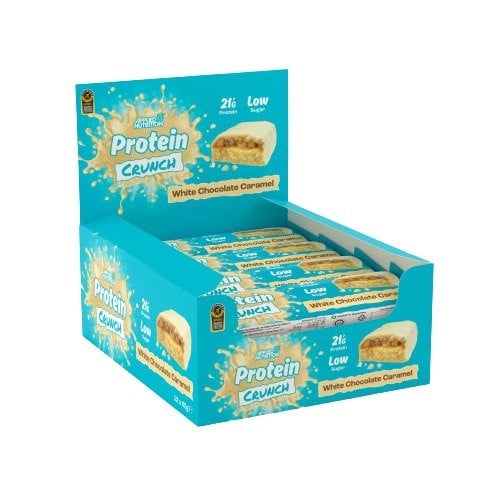
Protein bars are the most practical way to carry protein with you: no shaker, no water, you open them in your bag, at the office or in the car. Behind that wrapper, though, there is a small feat of food technology: fitting 20 g of protein into 60 g of product and making it soft, crunchy and tasty is anything but simple. This guide teaches you to read the label and understand what you are really eating.
What the law says: "source of" and "high"
The claims on the pack are not free. In the European Union (Reg. EC 1924/2006):
- "Source of protein" can only be used if at least 12% of the product's energy comes from protein;
- "High protein" only if protein provides at least 20% of the energy.
For these products the claims "protein contributes to a growth in and to the maintenance of muscle mass" and "to the maintenance of normal bones" are also authorised. The same goes for sugars: "low sugars" means at most 5 g per 100 g, "sugars-free" at most 0.5 g per 100 g, and "with no added sugars" means none were added, not that there are none.
Do the sum yourself
Protein provides 4 kcal per gram. Multiply the grams of protein in the bar by 4 and divide by the calories: a 220 kcal bar with 20 g of protein gets 80 kcal from protein, that is 36%. Well above the "high protein" threshold. With the same sum you will immediately spot the bars that are protein mainly in name.
Protein: how much and above all which
The ingredient list is in descending order of weight: the first ingredient is the one present in the largest amount. The most common sources are:
- Milk proteins (whey, casein, calcium caseinate, milk powder): the benchmark of classic bars, with a complete essential amino acid profile.
- Soy protein, often as crisps, the extruded crunchy balls that give the "crunch".
- Plant proteins (pea, rice, faba bean) in vegan bars, often blended to complete the amino acid profile.
- Hydrolysed collagen or gelatine: this is where to pay attention. On the label they count as protein and help keep the bar soft, but collagen contains almost no tryptophan, an essential amino acid: it is an incomplete protein. If it appears among the first protein sources, part of the declared grams are worth less than they seem.
For an in-depth comparison of protein sources read the guide Protein powder: how to read the label.
Sugars, polyols and fibre: the most technical part
To be low in sugar while staying sweet and soft, modern bars use three families of ingredients.
- Polyols (maltitol, sorbitol, erythritol, isomalt): bulk sweeteners that provide volume and texture. In the European nutrition table they sit within carbohydrates, on the "of which polyols" line, separate from sugars. They provide 2.4 kcal per gram against 4 for sugars; erythritol counts as 0. Above 10% added polyols the label must state "excessive consumption may produce laxative effects": if you are sensitive, it is the first line to check.
- Fibre (inulin, polydextrose, soluble corn fibre): provides 2 kcal per gram and in Europe is not counted within carbohydrates but on a line of its own.
- Intense sweeteners (sucralose, acesulfame K, steviol glycosides): a few milligrams are enough, so they do not weigh on calories.
Watch out for the "net carbs" on American labels: in Europe they are not a value provided for by law. On US labels total carbohydrates include fibre, on European ones they do not: two identical bars can look different just because of the calculation system.
How calories are calculated
EU Regulation 1169/2011 sets the factors: protein 4 kcal/g, carbohydrate 4 kcal/g, polyols 2.4 kcal/g, fibre 2 kcal/g, fat 9 kcal/g, erythritol 0. With these numbers you can rebuild the calories from the table and see where they come from: in many bars a large share comes from the fat in the coating and fillings, not from sugars.
Coating, fillings and texture
- "Chocolate" or "chocolate-flavoured coating": real chocolate has a composition set by law; a "coating" often replaces cocoa butter with other vegetable fats. If an ingredient is mentioned in the name, the list must state its percentage.
- Saturated fat: check it in the table, especially in bars with generous fillings and coatings.
- Why it hardens: over the months proteins aggregate and moisture migrates from the core to the surface, so the bar gets harder. It is normal and not a safety issue: store it somewhere cool and dry and check the best-before date. For the greedy ones, a few minutes in a pocket or in your hand makes it softer again.
Bar, cookie or flapjack
Besides the classic bar you will find protein cookies, oat-based flapjacks (more carbohydrates and fibre), crunch bars with crisps and caramel layers, and soft bars with a creamy core. If you are mainly after carbohydrates for a long activity, the right category is energy bars.
Work out the cost per 10 g of protein
- Protein in the box: grams of protein per bar multiplied by the number of bars. A box of 12 bars with 20 g of protein each holds 240 g of protein.
- Cost per 10 g of protein: price divided by the grams of protein, times 10. If the box costs €30: €30 / 240 g × 10 = €1.25 per 10 g of protein.
It costs more than protein powder: with a bar you pay for convenience, texture and taste. Doing the sum helps you pick the one that gives you the most for every euro.
In short
- "Source of protein" = at least 12% of energy from protein; "high protein" = at least 20%. Do the sum with 4 kcal per gram.
- Check which proteins are inside: collagen counts on the label but is incomplete.
- Polyols and fibre sweeten and add texture with fewer calories; above 10% polyols there is the laxative-effects warning.
- "Net carbs" are not a European value: compare tables with the same system.
- Compare bars on cost per 10 g of protein.
Protein foods should not be used as a substitute for a varied and balanced diet and a healthy lifestyle. Check the allergens on the label (often milk, soy, nuts, gluten, eggs). If you have a medical condition, ask your doctor first.
Products in this guide
- -10%


- -10%


- -10%


Applied Nutrition
- -10%
