Mushroom supplements: what they do and how to read the label
What a mushroom complex is, which mushroom claims were rejected or are on hold, whether cordyceps improves endurance, what changes between fruiting body and mycelium and how to read extraction ratio, polysaccharides and beta-glucans.
Reishi, cordyceps, lion's mane, chaga: mushroom supplements are more and more popular, often in blends called mushroom complex. This guide explains what is inside, what European law really says about their effects and how to read the numbers on the label: species, part of the mushroom, extraction ratio, polysaccharides and beta-glucans.
What is a mushroom complex?
It is a blend of powders or extracts from several mushroom species in the same serving. Trade names change from brand to brand, so look for the Latin name on the label:
| Common name | Latin name |
|---|---|
| Reishi | Ganoderma lucidum |
| Cordyceps | Ophiocordyceps sinensis (formerly Cordyceps sinensis), Cordyceps militaris |
| Lion's mane | Hericium erinaceus |
| Chaga | Inonotus obliquus |
| Shiitake | Lentinula edodes |
| Maitake | Grifola frondosa |
| Tremella | Tremella fuciformis |
| King trumpet | Pleurotus eryngii |
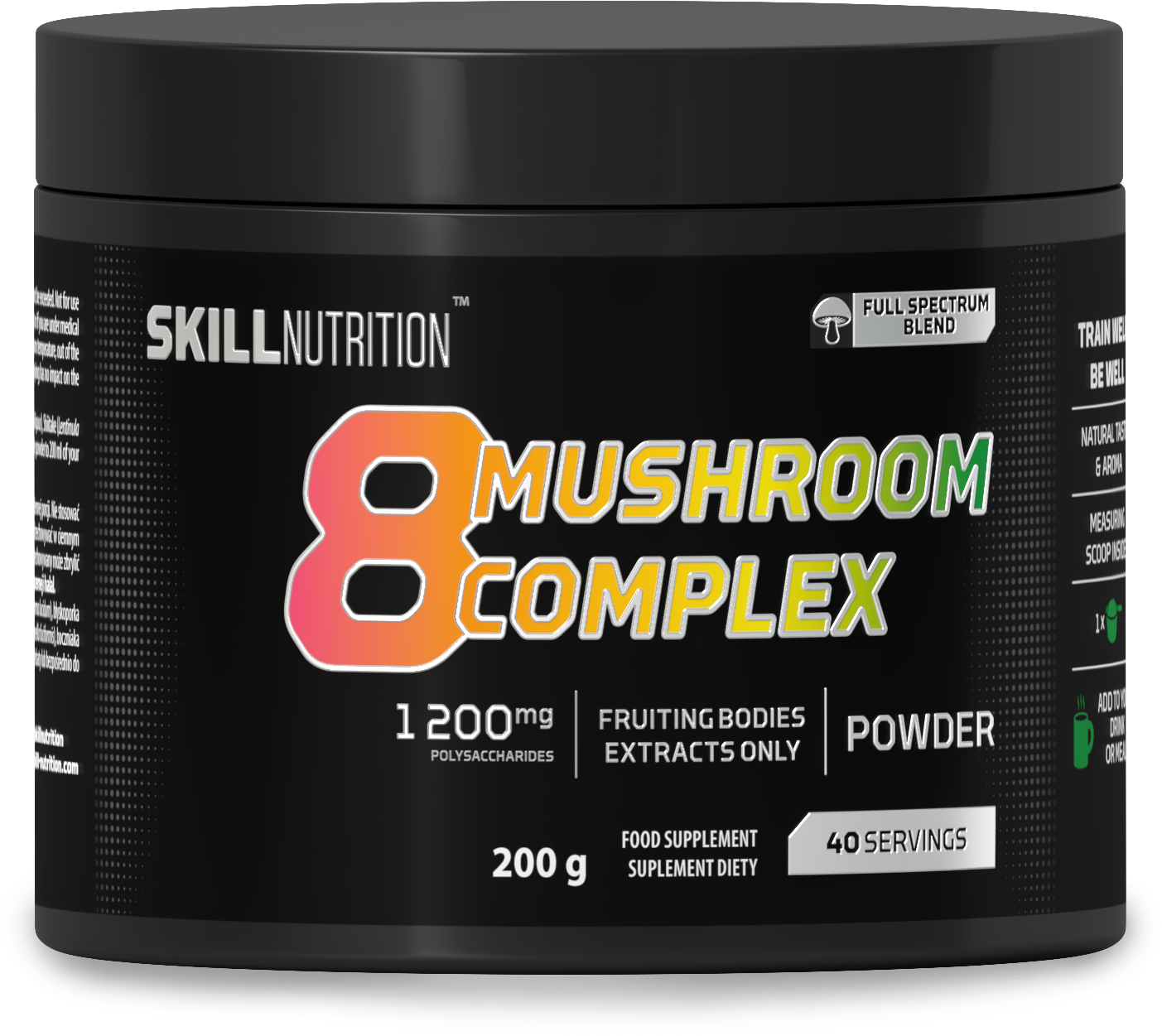
In our catalogue, for example, Skill Nutrition's 8 Mushroom Complex and Applied Nutrition's Mushroom Blend combine eight species in powder form, while Swanson's Lion's Mane and Cordyceps contain a single mushroom, in capsules. You will find them in the Stress and Concentration category.
What are mushrooms in supplements for?
As far as the law is concerned, the answer is short: no health claim for mushrooms is authorised in the European Union. The claims submitted for mushrooms have had three outcomes.
- Assessed and rejected. Among them, for cordyceps «Increases performance and endurance of a heavy exercise» and «Supports immune system»; for reishi «Stimulates the body in exhaustion»; for shiitake and maitake those on the body's natural defences. In the EU register they are not authorised.
- On hold. For reishi and Agaricus blazei some claims on immune defences are on the list of plant claims that EFSA has not yet assessed: they are neither authorised nor rejected.
- Withdrawn by the applicant, such as the one on lion's mane.
In practice, a mushroom supplement sold in Europe has no authorised claim to say that it strengthens your defences, gives you energy, improves focus or endurance. If a label or an advert promises it, that sentence has no backing in European law.
Does cordyceps improve endurance?
It is the most common promise among people who train, and it is one of the rejected ones: for Cordyceps sinensis the claim on sports performance and endurance was judged not substantiated and is not authorised.
There is also a labelling question. Wild cordyceps grows on the Tibetan plateau above 3,000 metres, about 100 tonnes are collected each year and it is protected in China as an endangered species. According to a review of the Chinese cordyceps industry (Dong and colleagues, Mycology, 2015), cultivating the fruiting body had not succeeded: this is why mostly fermented mycelium is produced, for example the Cs-4 strain of Paecilomyces hepiali, or Cordyceps militaris is grown instead. Swanson's Cordyceps, for example, states on the label a cultivated mycelia extract of Paecilomyces hepiali, 1.2 g per 2-capsule serving. When you read «cordyceps», check which species and which part is really inside.
Do mushroom beta-glucans lower cholesterol?
Mushrooms contain beta-glucans, but the authorised claim on cholesterol is about something else: beta-glucans from oats and barley. Word for word, in the register: «Beta-glucans contribute to the maintenance of normal blood cholesterol levels», only for foods with at least 1 g of beta-glucans from oats, oat bran, barley or barley bran per portion, with the information that the effect is obtained with 3 g a day. Mushroom beta-glucans are not included, and the claims on yeast beta-glucans for immune defences were rejected.
Are mushrooms in supplements novel foods?
A food that was not consumed to a significant degree in the European Union before 15 May 1997 is a novel food and, under Regulation (EU) 2015/2283, it must be authorised before it can be sold. The European Commission's novel food catalogue looks at each species and, above all, at each part:
- the fruiting body of reishi, lion's mane, shiitake, maitake and tremella is not novel in food;
- chaga (fruiting body and water and ethanol extracts), Ophiocordyceps sinensis (mycelium and fruiting body) and Paecilomyces hepiali mycelium are not novel in food supplements;
- dehydrated mycelium powder of reishi, lion's mane, shiitake, maitake, tremella and king trumpet, and Cordyceps militaris, are instead listed as novel foods not yet authorised;
- shiitake mycelial extract is an authorised novel food: a sterile aqueous extract obtained by fermentation, with its own dose and conditions of use.
In Italy, the mushrooms allowed in food supplements are listed in a dedicated section of the Decree of 10 August 2018 (annex 1, «Funghi»), which gives the traditionally used part for each species: for reishi, shiitake, maitake and lion's mane it is the sporophore, that is the fruiting body; for chaga it is the sclerotium. For mushrooms the list sets no doses and no label warnings.
Fruiting body or mycelium: what difference does it make?
The fruiting body is the part you see, the mushroom proper. The mycelium is the network of filaments that grows in the substrate. Many mycelium products are grown on cereals and also contain the substrate, that is starch.
A study of nine reishi, shiitake and maitake preparations (PLOS ONE, 2019) measured 0.8 to 1.3% alpha-glucans, the group starch belongs to, in fruiting body extracts, and 12.6 to 17.8% in products with mycelium and substrate. In mushrooms, the authors note, beta-glucans are typically between 10 and 40% and alpha-glucans below 5%. Their conclusion: a fruiting body product and a mycelium product cannot be compared on beta-glucans alone. This is why it helps when the label says which part of the mushroom is inside.
How do you read extraction ratio and polysaccharides?
A 10:1 extract means that 10 g of dried mushroom went into 1 g of extract. The ratio tells you how much raw material was used, not how much active compound there is: for that you need a measured figure.
- In Skill Nutrition's 8 Mushroom Complex a 5 g serving contains 500 mg of fruiting body extract for each of the eight species, with ratios from 10:1 to 30:1, and each extract is standardised to 30% polysaccharides: 150 mg per species, 1,200 mg per serving. With those ratios, the 4 g of extracts correspond to 60 g of fruiting bodies, as the product page states.
- In Applied Nutrition's Mushroom Blend the 4 g serving contains 500 mg per mushroom, all 10:1 extracts: 5 g of mushroom per species, 40 g in total. The product page does not give the polysaccharide percentage.
- Swanson's Lion's Mane contains 500 mg of whole mushroom per capsule («full spectrum»): it is not an extract, so there is no ratio.
Be careful with polysaccharides: it is a less precise figure than beta-glucans, because it also includes complex sugars that do not come from the mushroom, such as starch or maltodextrin used as fillers. In a study of 19 reishi supplements bought in the United States (Wu and colleagues, Scientific Reports, 2017) starch-like polysaccharides, absent from the reishi fruiting body, were found in 13 products, and only in 5 did the measured ingredients match the label. If the label states beta-glucans, that is the most useful figure.
How much should you take and what are the warnings?
Follow the daily dose shown on the label and do not exceed it. The product pages in our catalogue carry similar warnings: not suitable for under-18s or for women who are pregnant or breastfeeding. If you take medication or have a medical condition, ask your doctor before using them, and add up the doses if you take more than one product with the same mushrooms, for example a blend and a single mushroom.
How do you choose a mushroom supplement?
- Species: look for the Latin name of each mushroom, not only the trade name.
- Part used: fruiting body, mycelium or whole mushroom.
- Amount per species: in a blend, the milligrams of each mushroom per serving, not only the total.
- Extract or powder: if it is an extract, the ratio (10:1, 20:1) and the measured figure, polysaccharides or better beta-glucans.
- Promises: be wary of energy, defences, focus or endurance attributed to mushrooms, because no claim of this kind is authorised.
In short
- A mushroom complex is a blend of several mushrooms: read the Latin names and the amount of each.
- In the European Union no health claim for mushrooms is authorised: those on endurance, energy and defences were rejected or are still on hold.
- The claim on beta-glucans and cholesterol only applies to those from oats and barley.
- Fruiting body and mycelium are not the same thing: novel food status and composition change.
- The extraction ratio tells you how much raw material was used; the most useful measured figure is beta-glucans.
- Follow the label dose and the warnings, and ask your doctor if you take medication.
Products in this guide
- -10%


Swanson
- -10%


- -10%


Applied Nutrition
- -10%

Skill Nutrition