How to choose shoes for lifting weights
Flat sole, raised heel or cushioned sole: what changes in the squat according to studies, whether a high top helps, how to choose your size and when to use different shoes outside the weights room.
Most people who start lifting weights use the running shoes they already own. Sooner or later the question comes up: do you need dedicated shoes? And if so, which ones? This guide explains what changes between a flat sole, a raised heel and a cushioned sole, what studies on the squat have measured, and what to look at when you choose. The scientific evidence exists, but it is less clear-cut than you often read.
What types of shoes are used in the weights room?
| Type | Sole | For what | Examples |
|---|---|---|---|
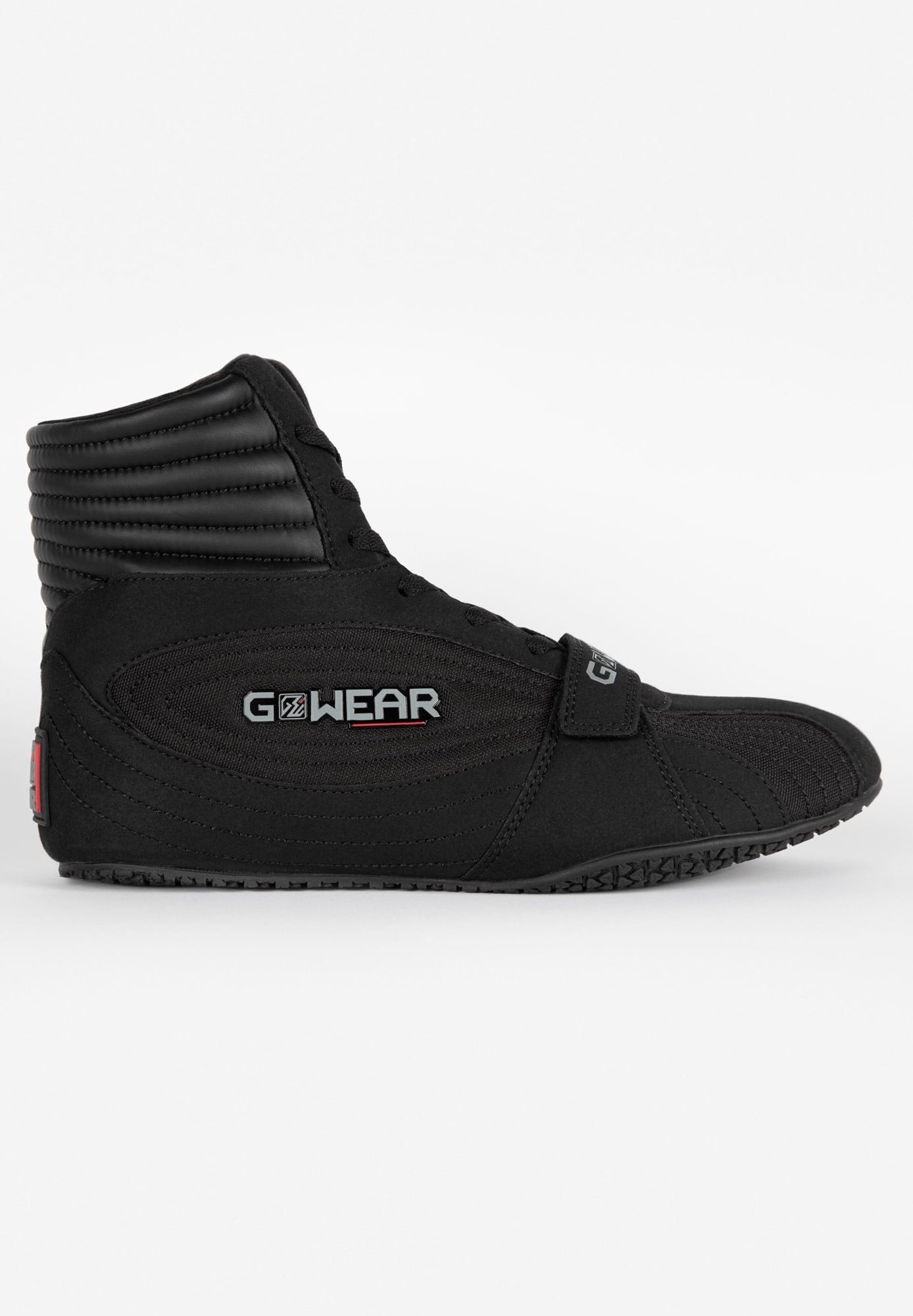
| High-top bodybuilding shoes | flat, low and firm | squats, deadlifts, leg press, weight training | Gwear Performance High Tops, Gwear Classic High Tops, Gwear Pro High Tops |
| Weightlifting shoes | rigid, with a raised heel | deep squats, clean and jerk, snatch | not in our range |
| Training shoes | softer, sometimes with a raised midsole | circuits, functional training, light weights | Gym Hybrids, Gwear Essential Training Shoes |
| Running shoes | thick and cushioned | running and cardio | the ones you already have |
The bodybuilding shoes we sell are almost all of the first type: high top, flat sole, reinforced heel and, on many models, a lace-and-Velcro closure.
What do studies say about shoes in the squat?
The barbell back squat is the most studied exercise, and the results need to be read together:
- A raised heel changes the angles. A 2026 meta-analysis of 14 studies and 177 people found that with the heel raised the ankle and knee bend about 4-5 degrees more, while hip and trunk do not change on average. At the ankle the effect only shows with high raises, above 2.5 cm. A 2021 review reports that weightlifting shoes reduce trunk lean compared with running shoes and bare feet.
- It is not protection for your back. In a 2019 study of 14 recreational lifters at 80% of their one-rep max, bare feet, a heel raise and weightlifting shoes changed neither trunk angles nor back muscle activation. The authors conclude that a raised heel is unlikely to protect against back injuries.
- Who wears them matters. In Legg's study (2017) experienced lifters made more use of the heel than beginners, and the more upright trunk only showed without load.
- A cushioned sole changes things too. In running shoes the squat was deeper than barefoot (Sinclair, 2015), and the ankle bent more than in weightlifting shoes (Whitting, 2016). In Sinclair's study, athletes still preferred to train barefoot.
In short: shoes change squat mechanics, but no study points to one type that is better overall. The authors of the 2021 review call for more data on beginners, women, sole stiffness and heel height.
How do you choose the sole?
For squats, deadlifts and leg press the most common choice is a flat, firm sole that keeps your foot close to the floor. In our view it is the starting point for people who mainly train with weights: no heel, so a stance similar to barefoot, and a sole that does not compress under load.
Flat-soled models differ: Gwear Pro High Tops have a thin, flexible sole and a low-cut heel to free up the ankle; Troy High Tops have a thicker, cushioned flat sole, also designed for everyday wear. If you struggle to squat down without lifting your heels, a raised heel is an option to discuss with your coach, knowing that it changes your technique.
Do you need a high top?
Gorilla Wear presents the high top as ankle support. The studies we read compare soles and heels, not high tops and low tops: we have no data to say how much it matters. In practice a high top, with laces and Velcro, keeps the foot locked in the shoe. If you prefer a free ankle, low training shoes such as Gym Hybrids or Essential Training Shoes are the alternative.
Which size should you choose?
- Check the model's fit. For Gorilla Wear High Tops and Chicago High Tops the manufacturer warns that they run small and recommends one size up.
- They are unisex. Gorilla Wear models are designed for men and women, in European sizes.
- Try them with the socks you wear to the gym and tighten laces and Velcro: your foot should not slide inside the shoe when you push.
Can you wear them outside the gym or for running?
A thin flat sole is made to stay stable, not to absorb the impact of running: keep your running shoes for cardio and runs. For everyday wear there are in-between models such as Troy High Tops or Gwear Urban Motion Shoes, which have a cushioning sole. If you want an alternative to Gorilla Wear, there is the GASP Zeus Thunderbolt V2, in suede with a rubber sole.
What this guide cannot tell you
The studies cited are small (9 to 32 people, 177 in the meta-analysis), almost always experienced men, and only on the barbell back squat: we do not know how far they apply to deadlifts, leg press or beginners. None of them measures high tops. And we do not sell raised-heel weightlifting shoes: if you think you need them, look for them in a specialist shop.
In short
- For weights a flat, firm sole is the usual choice; a raised heel changes ankle and knee angles.
- The studies do not show that a raised heel protects your back.
- A high top keeps the foot locked in; nobody has measured how much it helps the ankle.
- Some models run small: read the fit on the product page.
- For running, use running shoes.
All models are in the Bodybuilding Shoes category and on the Gorilla Wear and GASP brand pages.
Products in this guide
- -20%


- -20%


- -20%


- -20%


Gorilla Wear